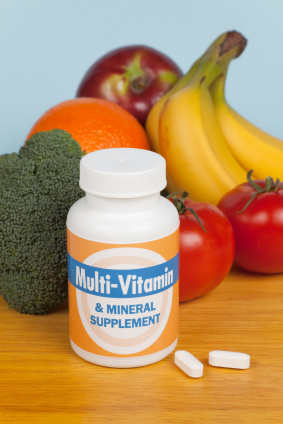
Why Can't Your Body Just Make Vitamins?
Why Can't Your Body Just Make Vitamins?
By: Dr. George Obikoya
This is an excellent question whose answer is straightforward. Since generally we cannot synthesize vitamins or can only do so in amounts insufficient to meet our body needs, they must be obtained from the diet or from some synthetic source, hence vitamins are called essential nutrients. Since the body simply cannot make many of the vitamins it needs, a good liquid multivitamin is crucial. If a vitamin is absent from the diet or is not properly absorbed by an organism, a specific deficiency disease may develop or the individual may feel tired, irritable and may not be as mentally sharp.
Let's use a car analogy real fast. Bear in mind that you only get one body, but you can always buy a new car. Try and think of your body as a well oiled machine, with thousands of interlocking parts, gears and spokes if you will, that all support each other and work together to seamlessly sustain life on a daily basis. This, at least in a simplified way, is how your body works - but we all know the kinds of harmful effects that malnutrition, disease and injury can have on a person. When your body lacks the essential raw ingredients it needs to operate properly, a cascading effect occurs that touches on every single one of your body's systems and causes them to operate less efficiency or even cease functioning altogether. Taking supplemental liquid vitamins is akin to using high octane gas for your car, only hundreds of times better and far, far less expensive. Your body runs better, cleaner, more efficiently and is able to better resist breaking down and disease as a result. Your immune system functions better, your thinking clears and your body simply works better when it has the proper nutrients it needs. Unfortunately a side effect of our diet means that millions of people every day are lacking the most basic nutrition needed, let alone getting optimum nutrition levels.
There are two groups of essential vitamins, each classified according to the materials in which they will dissolve. Fat-soluble vitamins, A, D, E and K, dissolve in fat before they are absorbed in the blood stream and are stored in the liver.
Water-soluble vitamins on the other hand dissolve in water, are not stored and are eliminated regularly in urine. We, therefore, need a continuous supply of these vitamins. The water-soluble vitamins are the B-complex group and vitamin C. Water-soluble vitamins are easily destroyed or washed out during food storage or preparation (heat, light, etc). To reduce vitamin loss, refrigerate fresh produce, keep milk and grains away from strong light, and use the cooking water from vegetables to prepare soups.
Vitamin C is plentiful in citrus fruits, broccoli, strawberries, melon, green pepper, tomatoes, dark green vegetables, potatoes. You get a lot of Vitamin B1 in pork, liver, whole grains, enriched grain products, peas, meat, legumes. Liver, milk, dark green vegetables, whole and enriched grain products, eggs are excellent sources of vitamin B2. Niacin can be found in liver, fish, poultry, meat, peanuts, whole and enriched grain products.
Pork, meats, whole grains and cereals, legumes, green, leafy vegetables are rich in vitamin B6, while liver, kidney, dark green leafy vegetables, meats, fish, whole grains, fortified grains and cereals, legumes, citrus fruits are great sources of folic acid.
Vitamin B12 is found only in animal foods such as meats, liver, kidney, fish, eggs, milk and milk products, oysters, and shellfish and it needs an additional "intrinsic factor" produced in the stomach to function properly. Liver, kidney, meats, egg yolk, whole grains, and legumes are good sources of panthotenic acid, which is also made by intestinal bacteria. Biotin is found in the liver, kidney, egg yolk, milk, most fresh vegetables, and it is also made by intestinal bacteria. Vegetarians should strongly consider supplemeting with these B vitamins, lest they fail to obtain enough from their diet.
An important point to note is that we absolutely need vitamins to function effectively and be healthy. Our bodies cannot make many of the vitamins that we require on a daily basis. We must, therefore, find them in our food, and by taking a liquid multivitamin supplement.
A good multivitamin is the foundation of health and nutrition. Take a look at our scientific reviews of many of the popular brands for factors such as ingredients, areas of improvement, quality level, and overall value. If you are looking for a high quality liquid multivitamin, we suggest that you take a look at the Multivitamin Product Comparisons.
References
Alexander, S.W. 1995. Specific nutrients and the immune response
Nutrition: 11:229
